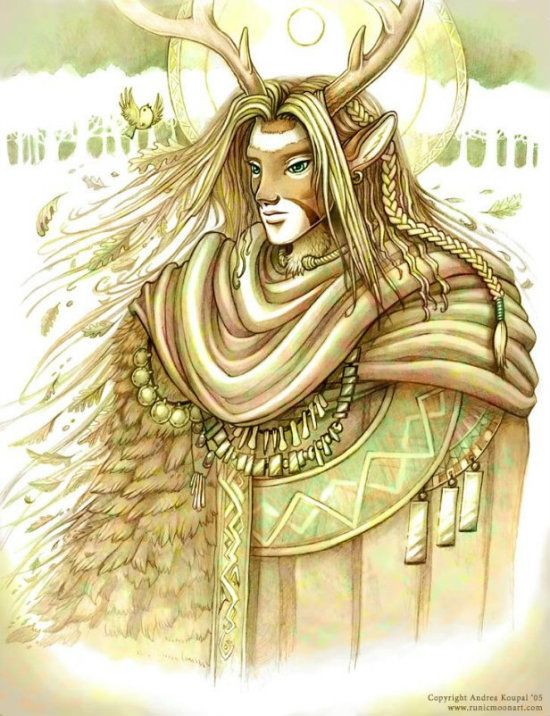
Other names are: Breo Saighead, Brid, Brighid [Ireland], Brigindo, Brigandu [Gaul], Brigan, Brigantia, Brigantis [Britain], Bride [Alba, or Scotland]. Breo Saighead, or the "Fiery Arrow, or Power," is a Celtic three-fold goddess, the daughter of The Dagda, and his wife Bres. Known by many names, Brigit's three aspects are:
1. Fire of Inspiration as patroness of poetry,
2. Fire of the Hearth, as patroness of healing and fertility, and
3. Fire of the Forge, as patroness of smithcraft and martial arts.
Brigit: the manifold of a goddess through the centuries
I am She
who is the natural Mother
of all things,
Teacher and governor
of all elements,
The initial progeny of worlds,
The head of divine power,
Queen of all those who are in the underworld,
The most important one among those
living above,
Only manifestation
and under the single form
of all Gods and Goddesses.
Brigit can be seen as the most powerful religious form in the entire Irish history, as she is one of the most complex and contradictory goddesses of the Celtic pantheon. Many layers of separate traditions have crossed, creating her indisputably complex story, spanning many centuries. She managed to pass intact through generations, filling different roles in different periods.
She was, and still is, a Goddess with many faces: Bride, Bridey, Brighid, Brigit, Briggidda, Brigantia. There are many more variations on pronunciation; a possible one could be “Breet”.
Brigit is the traditional patroness of healers, of poetry and of smiths, all deeds of inspired and practical wisdom. Since she’s a solar divinity, her attributes are light, inspiration and all deities associated to fire. Even if she couldn’t be identified with the physical sun, she certainly is the origin of inner vital and healing energy.
Her name derives form the root “breo” (fire): forge’s fire combined with the fire of artistic inspiration and healing energy. Brigit, daughter of the Great God Dagda and Celtic counterpart to Athena/Minerva, is the keeper of tradition, since poetry represented a sacred art for the ancient Celts, transcending the simple verse composition and becoming magic, ritual, personification of the ancestral memory of populations.
The Druid mysteries of healing were also under Brigit’s aegis, which is proved by the numerous “sources of Brigit”. Widespread in the UK, some of them have kept numerous traditions to date regarding their healing qualities. Countrymen still hang, on branches of trees growing nearby, strips of fabric or ribbons indicating the illnesses from which they want to be healed.

The mirror, the goblet and the spinning wheel were sacred to Brigit. The mirror is a tool of divination and symbolises the Other World, to which heroes and initiated have access. The spinning wheel represents the centre of the Cosmos, the turn of the Wheel of the Year and also the wheel that spins the threads of our lives. The goblet represents the womb of the Goddess that gives birth to all things.
King Arthur’s sword, Excalibur, was forged by the Lady of the Lake, a figure often associated to Brigit for her role of forger and for the fire. Like the Arthurian Avalon, or Isle of Apples, Brigit has an apple orchard in the Afterworld, to which bees travelled to obtain its magical nectar.
Brigit, meaning “she who exalts herself”, is the Goddess of the sacred flame of the Kildare (from Cill Dara, meaning ‘church of the oak’) and often is considered to be the White Maiden aspect of the threefold Goddess. Gailleach, or White Lady, drank from the ancient Well of Youth at dawn: in that instant, she was transformed into her maiden aspect, the young goddess named Brigid. She was Christianised as the "foster-mother" of Jesus Christ, and called St. Brigit, the daughter of the Druid Dougal the Brown. Sometimes she is also associated with the Roman-Celtic goddess Aquae-Sulis [currently Bath, Somerset, UK].

 |
| The Cathedral Church of St. Brigid, Kildare - Ireland |
 |
| St. Brigid |
One of her most ancient names is Breo Saighead, meaning “burning arrow”, name that depicts attributes of punishment and divine justice.
Three rivers have been named after her: Brigit, Braint and Brent respectively in Ireland, Wales and England. In modern Great Britain, she’s referred to as the maiden warrior Brigantia and is venerated not only as justice and authority, but also as the personification of Great Britain itself.
There is a 12th century story in which Merlin got inspired by a feminine figure representing the sovereignty of Great Britain, which history is caused by her visions. Moreover, Taliesin describes a traditional cosmology inspired by Brigantia. In many stories there is also a reference to her nurture for the development of human potential.
She is associated to the cow with reference to the festival of Imbolc. In this celebration, which is entirely dedicated to her, the light of fire, purification by well’s water and the beginning of a new year are present. The importance of Imbolc is so profound that deserves separate attention.

Apart from her totemic animals, the cow and the sheep, Brigit is also associated with the rooster, announcer of a new day, and the snake, symbol of regeneration. In many cultures, the snake is also symbol of the Earth’s spirit and of natural forces of growth, decay and renovation. For this reason, Brigit is connected to the goddesses of fertility, many of whom are represented with snakes, which are also a recurrent theme in Celtic jewellery (another product of the forge).
Brigit’s story starts in a triad of sisters, not unusual in the Celtic world. She’s the daughter of Dagda and the Morrighan, sister of Ogma, god of the sun and of the creator Ogham. She had three sons: Brian (Ruadan), Luchar and Uar, the deeds of the former being significant in her development as a goddess of peace and unity. It is vital to consider that for the Celts lineages were strictly mater-linear and that maternity was highly respected.

Christianised as Saint Bridget or Bride, as she is familiarly addressed in Gaelic, she is considered as the miraculous midwife and adoptive mother of Jesus Christ and is celebrated on February 1st, day of Saint Bridget or La Fheile Brfd. As far as this saint of dubious historic existence – but of certain pagan origins - is concerned, it is said she had the power to multiply food and drink to nourish the poor, and that she could turn into beer even the water she washed with! The Irish monastery of Kildare was consecrated to her; in it, a fire was constantly kept alight in her honour by nineteen nuns. Each nun watched over the fire for a whole day on a twenty day cycle; when it was the turn of the nineteenth nun, she had to pronounce the ritual formula: “Bridget protect your fire. This is your night.” On the twentieth day, it is said that it was Brigit herself who miraculously kept the fire ablaze.
The number nineteen revokes the Metonic lunar cycle that repeats itself identically every nineteen solar years. Needless to remind that this custom recalls the board of the Vestal Virgins whose task was to keep the sacred fire of ancient Rome constantly alight; most probably though the devotion of the Kildare’s nuns is connected to the Galliceniae, a legendary sisterhood of Druidesses who used to jealously guard their sacred fences from men’s intrusion and whose rites were maintained through many generations.
Similarly, only women were allowed to enter the sacred yard at the Kildare monastery where the fire burned and was kept alive with a bellows, as Geraldo di Cambria recalls in the 12th century. The fire burned uninterrupted from the legendary foundation of the sanctuary, in the 6th century, until the kingdom of Henry VIII when the Protestant Reform ceased this more pagan than Christian devotion.


To grasp the importance of Imbolc, it is necessary to remember the life-or-death fight of the entire agrarian society represented by winter. In a world only lit up by fire, this season’s snow, cold and ice kept the population in a constant dangerous situation that resolved only with the arrival of spring. Even if the equinox only arrives on March 21st and spring is celebrated with Oestara and Beltane, Imbolc is the turning point indicating that better times are on their way.
Some questions were vital during the cold months: was there enough food for both humans and animals? Would disease decimate the clan, particularly children, women and the elderly? And what would be of animals whose lives were so important for humans? This was particularly true for impregnated cows and sheep, whose milk was not only used as drink, but also to prepare cheese and curds, food that could have a significant difference between life and death.
By Imbolc, these animals would have given birth to their offspring and their milk plentifully flowing. Milk was a sacred food for the Celts, the ideal form of nourishment due to its purity. The cow symbolised the sacredness of maternity and of strong and nourished life. Milk therefore wouldn’t come from a passive cow but from an active mother fighting for her children’s wellbeing.
Imbolc splits winter in half; winter months are ending and the promise of spring is round the corner. This festival gradually turned into the modern Candlemas with Saint Bridget and into the festivity of Mary’s purification also celebrated at this time.
This was a feminine celebration as well: women celebrated the virgin function of the Goddess Brigit. In the Hebrides, maybe named after Brigit or Bride, women from the villages gather together in some households and make an image of the ancient Goddess, dressing her in white placing a crystal on the heart centre. On Saint Bridget’s eve, Scottish women dress a bundle of oats with female clothing and sit it in a basket, “Brid’s bed”, with a phallic shaped stick on one side. Then they shout three times: “Brid has come, Brid is welcome!” and they let burn flambeaux and candles near the “bed” through the night. Finding the mark of the stick on the ashes the morning after will be a predic-tion of prosperity for the year ahead. The meaning of this custom is clear: the women prepare a place to welcome the Goddess inviting at the same time the fertilising power
of the God to join with her.

In Ireland, the custom is to prepare the so called Brigit’s crosses out of rushes and twigs, with four arms held in a circle to represent the solar wheel, symbol appropriate to a divinity of fire and light; the crosses are prepared the year before and kept until they are burned this very day.
The manufacturing of Brigit’s crosses probably derives from an ancient pre-Christian custom connected to preparing wheat seeds for sowing.
These symbolic objects made with vegetable material also revoke that light and heat are vital to the vegetation that, year by year, constantly renews itself. Ear of oats, wheat or barley etc, used to manufacture Brigit’s dolls came from the last sheaf of the previous year’s harvest.
In many European traditions, this last sheaf is called the Wheat’s Mother (or Oat’s, Barley’s, etc.) and the propitiatory doll made out of it is called the Wheat’s Maiden (or Oat’s, Barley’s, etc.). It was believed that the spirit of the cereal or the Wheat’s Goddess herself dwelled in the last sheaf harvested; as the ears of the previous harvest contain the seeds for the following one, so the old divinity of autumn and winter would transform into the young Goddess of spring, through that infinite chain of immortality that is the cycle of birth, death and re-birth.
The Celts and their traditions

A certain extent of difficulty is encountered when researching the Celts’ beliefs, practices and religion. We need to rely on other sources, since the Celts themselves never wrote anything about these issues – therefore classic Roman and Greek authors, Christian scribes who registered their history and myths, archaeological proofs and folklore are vital.
However, examining these sources is like holding a fistful of sand and watching it disappear between our fingers. It’s important to remember that classic authors had their own views in portraying populations they conquered as savages, to justify that not always they understood the Celts’ beliefs and customs, but had a tendency to interpret them with reference to their own beliefs. Christian scribes not always knew myths and had their own interest in promoting Christianity. As far as archaeology is concerned, this depends from what survived and has been found – there are areas in which nothing is known. Moreover, archaeological evidence must be interpreted by experts, whom – as classic authors – often made interpretation errors due to preconceptions in their own culture. In the past, for instance, skeletons were found wearing jewellery and were classified as females because in the archaeologists’ society only women would wear jewellery. Even if folklore often reflects beliefs and ancient practices, it is virtually impossible to state with certainty which aspects are ancient and which posterior.
Read more:
http://inovemondi.forumfree.it/?t=66644159